A Simple Resource Can Foster Empathy for Invisible Disabilities
I know first hand because I have been raising a wonderful son, Will, who suffered from a severe traumatic brain injury at the age of 6. He made a miraculous recovery and is now 19. His life is just beginning with a future filled with possibilities. He’s planning to pursue collegiate studies and currently holds a job at one of the coolest places in town – where you can spend hours playing arcades or driving go-karts!
Life with an invisible disability can be a challenge.
This journey has not been easy for Will or our family. The biggest challenge?
You can’t “see” a brain injury.

You can see interesting behaviors or unusual responses. You can see a distracted individual who comes across as disinterested or angry. You can hear remarks that don’t make sense because they don’t fit the context of the conversation. You can wonder why an individual forgot what you just told them short moments ago. You can see someone who isn’t paying close attention to what they’re doing and witness their mistakes.
This is not a phase my son is going through. He has learned many ways to face these challenges, but he will continue to face many of them each day of his life. When I try to explain the challenges he faces, I usually hear “A lot of kids are like that. He seems pretty typical to me.” I know they mean well, but that’s why I look for resources that are simple and easy to understand – and share.
Now, Will is on board with me to help others learn how to help their families when faced with diversity. When I find a new resource, we share it! Here’s one I hope you may find useful.
Did you know that people who have had a brain injury have many of the same challenges as people with autism?
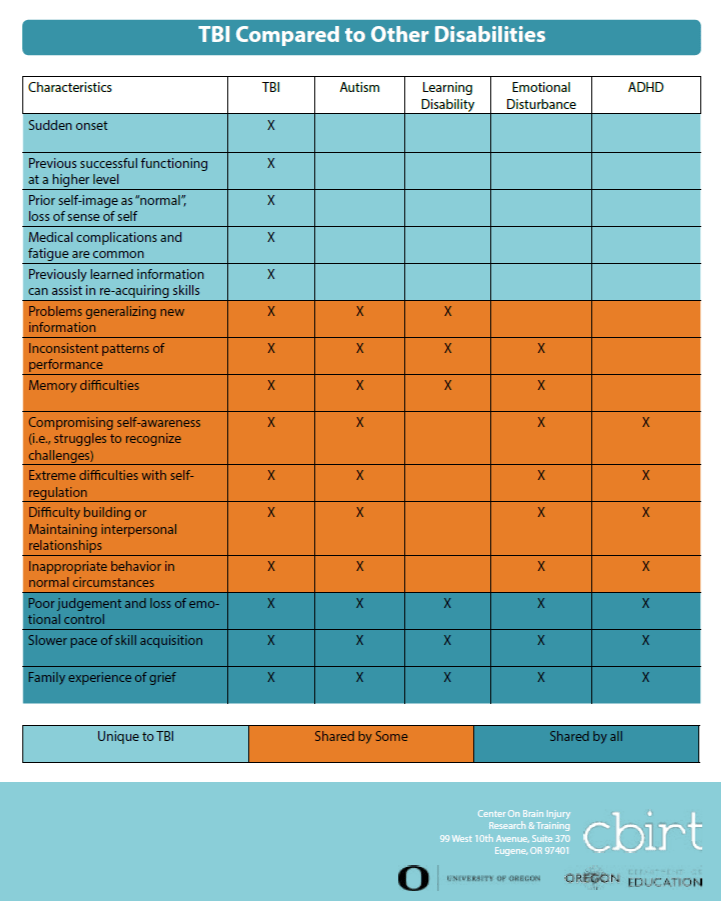
The best part? It’s quick! It only takes a few moments to look it over and see how every day tasks may actually be harder than it seems.
This is a guide we have used to gain empathy and understanding. Every time I use a resource like this or share it, the response is empathy, understanding, and many times a new perspective from educators, friends, family, and now employers.
Do you know someone who may benefit from this diagram?
Please share!
What are some other invisible disabilities that are similar to a TBI?
Invisible disabilities similar to a traumatic brain injury (TBI) often involve cognitive, emotional, or physical impairments that are not immediately visible. Here are some examples:
- Post-Concussion Syndrome (PCS): A set of symptoms that persist after a concussion, including headaches, dizziness, cognitive difficulties, and emotional changes.
- Chronic Traumatic Encephalopathy (CTE): A progressive neurodegenerative disease associated with repeated head injuries, leading to cognitive decline, mood disorders, and behavioral changes.
- Acquired Brain Injury (ABI): Brain injury occurring after birth due to various causes such as stroke, infection, or tumors, resulting in cognitive and functional impairments similar to TBI.
- Cerebral Palsy (CP): A group of neurological disorders affecting movement and muscle coordination, which can result from brain injury before or during birth.
- Neurocognitive Disorders: Includes conditions like dementia or Alzheimer’s disease, where cognitive decline affects memory, reasoning, and other mental functions, though they develop over time.
- Epilepsy: Recurrent seizures due to abnormal brain activity can lead to cognitive and emotional challenges that are not always visible.
- Attention-Deficit/Hyperactivity Disorder (ADHD): A neurodevelopmental disorder characterized by inattention, hyperactivity, and impulsivity, which can impact executive functions similar to those affected by TBI.
- Mood Disorders: Conditions such as bipolar disorder or major depressive disorder can result in significant cognitive and emotional challenges that may be less visible to others.
- Traumatic Stress Disorders: Includes Post-Traumatic Stress Disorder (PTSD), where trauma impacts cognitive and emotional functioning, similar to the effects of a brain injury.
- Complex Regional Pain Syndrome (CRPS): A chronic pain condition that can affect the brain and nervous system, leading to severe pain and disability that are not always outwardly apparent.
These conditions can share similar challenges with TBI, such as cognitive impairments, emotional difficulties, and physical limitations, even though they may have different underlying causes or manifestations.

 Mom with purpose changes name to "Orchestrated performance" - Marcy Renken
Leave a comment