Keeping up with the demands, many self-imposed, of being a parent can be exhausting! For years, I wanted to find a solution. I wasn’t looking for a solution, but I wanted one to find me!
Of course, I didn’t need a chore chart or calendar of appointments. I had it all together. I totally had control over the house and kids and the schedule. Everything had its place. Even my mother-in-law was impressed with my skills. Then, we had more kids. And more kids. And now we have six children, from ages 18 down to a 6-month-old.

Can you imagine how I would look if I still thought I could juggle it all? It would not be pretty.
Who am I kidding? I never really had it all together, but I’ve had moments where I thought I did. Of course, those were usually moments just before everything seemed to be falling apart.
But I’m a self-proclaimed SUPER NANNY! How could I not have it all together?
There is only so much I can do, so I have learned, before I need to have some sort of system to organize the chaos that is mom-ing. The systems we use now come from many years of trial, error, and rebooting. That’s right, I have started over more times than I can count.
I do love it when a friend notices my wall of organized chaos.
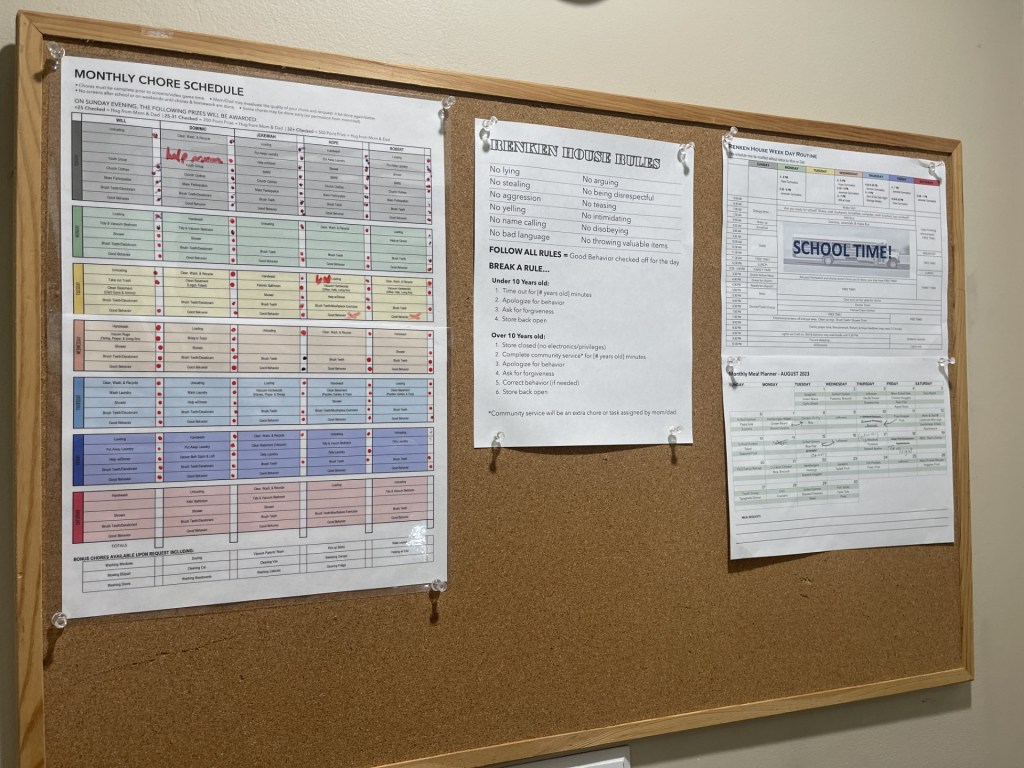
On the wall next to our garage door, you will see an array of organized charts. I have a meal plan for the current month of dinners, a schedule outlining an optimal day, a list of house rules, and a chore schedule. This magic command center has been slowly forming for over 16 years.
I’ve taken what I’ve learned that worked and what did not work for us. I hope you can take something away that may just add a bit more ease to your life.
Chores! Chores! Chores!
When I had shared an image of our chore chart a while back on social media, I received many comments. I decided to create a template for those of you who would like to copy or even use it as inspiration. If I did this correctly, you should be able to download it and put in your own family chores.
If you have a wonderful system that works, I applaud you. If you’ve tried to incorporate a plan but it failed, keep trying. I’m with you. If you are just getting started and can relate to my last post about treading water, rest assured. As I was doing the doggy paddle, I didn’t know where to start. Start here.
Who doesn’t love chores? If you are raising your hand, most of the rest of us are also. If you love chores, you are not normal. We still love you. Also, you need to share. Let the kids do some of your chores. (We also welcome you over to take care of our laundry.)
On the surface, just like many tools I’ve used, the template appears very simple. I would still find myself lost in the details. “It’s easy! Just insert your chores into the chart and the kids will complete them!” Sure. If you say so.
I’ve done a fair amount of research and made attempts to copy a variety of systems. I would spend hours looking up appropriate ages for different chores. What age should kids start chores? How much should each child have to do? How much is too much? Should I create a task list for them to follow? What should it look like? How will I enforce it? And on and on.
I have numerous folders filled with files on my computer where many great ideas have died.
This brings me to the chore chart we currently use. Now, each project in my system begins on a spreadsheet. Then, I simplify until it achieves my purpose. It has to be an easy system for me to track and enforce. This may be simple for you or seem overwhelming. No matter which is the case, I will walk you through my process and hopefully aid you in yours.
STEP 1
Take a piece of paper (or download your FREE Weekly Chore Plan) and write down each room in your house.
| Kitchen | Living Room | Main Bedroom | Main Bathroom |
| Girls’ Room | Boys’ Room | Laundry Room | Hall Bathroom |
STEP 2
Under each room, write down the chores you want completed regularly for that space. Also note how frequently the chore should be done. For this exercise, it can be daily up to weekly. For spring cleaning and anything that is less frequent than monthly, leave them off this exercise. Keep it simple if you can.
| Kitchen Dishes – daily Sweep – 3x/week Trash – weekly | Living Room Vacuum – weekly Dusting – weekly | Primary Bedroom Vacuum – weekly Dusting – weekly Laundry – weekly | Primary Bathroom Tub – weekly Counters – weekly Toilet – weekly |
| Girls’ Room Tidy – 3x/week Vacuum – weekly | Boys’ Room Tidy – 3x/week Vacuum – weekly | Laundry Room Sort/Wash – weekly Folding – weekly Put Away – weekly | Hall Bathroom Tub – weekly Counters – weekly Toilet – weekly |
Keep this list handy and we will add some routines to the list of chores.
STEP 3
While this post is about creating a chore chart to help maintain or clean up the chaos, it is also important to encourage other positive behaviors in our children. I’ve found that rewarding my children for doing things I want them to do has been a great way for them to make good choices more frequently, even without my request. Specifically, I’m talking about good behavior, following house rules, hygiene, and social behavior which for us includes church. You may even have specific areas you are working on with your child which you can add to the chore system.
For me, the chore chart and behavior system (more on this later) should work hand in hand. Using both systems together has given my daily management of household chaos an easy-to-follow simplicity which can be used on the craziest of days.
When I create my weekly chore plan, I keep the same plan for a minimum of one month. Often, I keep the same plan for the entire school year or the entire summer.
Download your FREE Weekly Chore Plan printable and join the MWP Tribe HERE
Create a list for each child in your home. Once you have their names written down, list routines and behaviors you would like to see from each child. Just like above, note how often you would like to see the routines/behaviors take place. I’ll demonstrate using some of my own children.
| Dominic Shower – 3x/week Good Hygiene – daily Good Behavior – daily Church Clothes – weekly Youth Group – weekly | Jeremiah Shower – 2x/week Good Hygiene – daily Good Behavior – daily Church Clothes – weekly Sunday School – weekly | Hope Shower – 2x/week Good Hygiene – daily Good Behavior – daily Church Clothes – weekly Sunday School – weekly |
If your child is in sports or has a routine appointment, you can reward them for participation. This is especially useful if there is something they are not looking forward to attending or resist going to. When we first introduced our children to gymnastics, they didn’t always want to go because they didn’t want to miss out on video games or free time. We started rewarding them for going and it shifted their mindset. Now, they don’t resist going and enjoy being there (mostly).
The chore chart can help you to maintain your priorities. Sometimes, doctor’s appointments or counseling or a church event may be the last thing one of my kids wants to attend. However, if it is important enough for me to take them, despite their reservations, I can reward them for their obedience. I have found that my kids may be anxious or nervous because of uncertainty or perhaps they had a negative experience previously (Uh, hello! Many doctor’s appointments end up with a shot!). A simple reward or checkbox on the weekly chore sheet is all I typically need to help them overcome their fears.
The next steps will look different depending on how many children you have. With fewer children, you can create a more robust system. For me, I just want simplicity so no matter how many children I have at home, it is easy to follow. The hardest part is here, in the brainstorming and prioritizing.
STEP 4
Use the chore list and individual kid’s task list to create a schedule for each one. Place a checkmark next to chores on your list when you assign them to track what’s left. If there are any chores left over, you may choose to take care of them yourself or, as I prefer, add them to a bonus chore list. Additional chores are a way for your kids to make up for any lost points. I also refer to the bonus chore list when my kids need additional work, like after they had their store closed for breaking a rule. (More on that in a later post.)
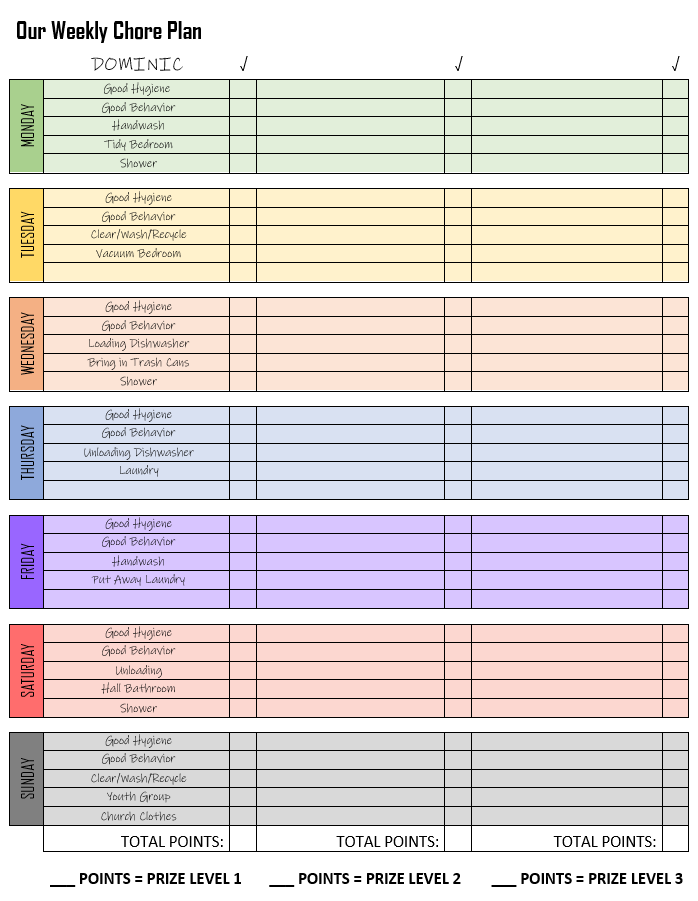
My general rule of thumb for chore assignments is to keep them simple, especially during the school year. As a parent, you can choose how much responsibility you would like each child to have. You may assign them one room each day to clean or you may wish to break it down into individual tasks throughout the week. Breaking it down is especially helpful to younger children. I use a combination of both for our family chart. Although I listed dishes as one task above, I broke it down so each child has a dish chore every day. For example, we have 4 separate dish chores: unloading the dishwasher, loading the dishwasher, handwashing, and clear/wash the table and counters. However, the bathrooms are each considered one chore for the older kids. With more kids in the house, you can be creative.
Here’s what it looks like using our 13-year-old as a model. I used the tasks from my lists above (in yellow text):
Download your FREE Weekly Chore Plan printable and join the MWP Tribe HERE
Whew! The hard part is done.
You’ll notice on my example above using Dominic, there is a place to write how many points it takes for 3 different prize levels. If you choose to offer a weekly allowance at one set rate, you may do that. In our system, we tally all possibly points and award prizes. You can see Dominic has 32 total tasks to complete each week. I would set the prize levels like this:
24 POINTS = PRIZE LEVEL 1 25-30 POINTS= PRIZE LEVEL 2 31+ POINTS = PRIZE LEVEL 3
As far as prizes go, that is up to you. We have taken the kids’ input as well. In the past, we have used screen time, $$, candy, snacks that we wouldn’t ordinarily allow, fidgets, an activity such as extra time with mom/dad, trips to the park, ice cream, sleepovers, choosing cereal for dinner if they don’t want what we are having. You can be as creative as you would like. Or, you can simplify by offering $2/Level 1, $3/Level 2, $5/Level 3. Currently, we have only 2 prize bins. I include prizes valued under $2 in one. The 2nd prize bin contains prizes that may be worth as much as $5.
We check in with the kids right after school to make sure they know they should get chores for the day and homework done prior to free time. We do allow them to have free time before school and on weekend mornings. Of course, mom and dad want to sleep in!
If you stay tuned, I will let you know how this chore plan ties in with our house rules, schedule, and meal plan.
If you would like to work with me and create you own custom plan and visual chart for your chore system, let me know!
Happy planning. You’ve got this! When you’re stuck, I’ll be here to help.

 Mom with purpose changes name to "Orchestrated performance" - Marcy Renken
Leave a comment